
What Happens When a Judge Treats Addiction as a Health Issue
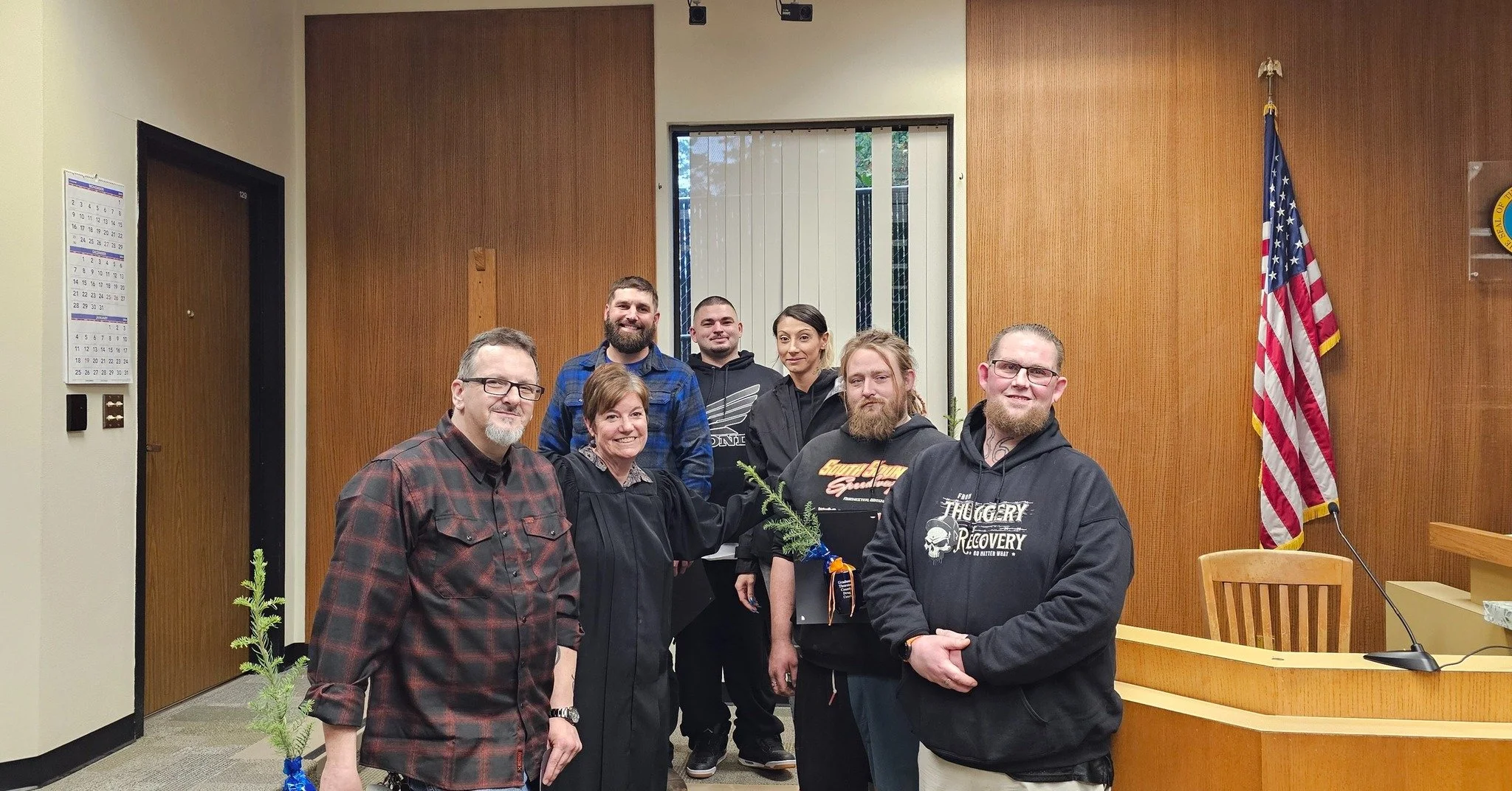
From left: Steve Fenton, Judge Wilson, Michael Gottbreht, TJ Matson, Rosa Sanchez-Anderson, James Wyse, and Dan Dittlow.
Navigating the legal system can be a scary, solemn journey filled with rules and formalities. Its outcomes can influence a participant’s life for years to come. Too often, individuals facing addiction and mental health challenges find themselves trapped in a repeating cycle of law enforcement involvement, court appearances, and incarceration.
Thanks to Thurston County’s therapeutic courts—and the support of the Strophy Foundation—that cycle can pause or even end altogether. Instead of facing felony arrest, charging, and a jury trial, Drug Court participants have their cases put on hold. Drug Court, which Judge Mary Sue Wilson explains is a pre-trial diversion program, allows the legal process to pause as long as participants meet all program requirements. Upon graduation, the prosecutor dismisses their conviction.
Wilson has served as a Superior Court judge for eleven years and has worked with Drug Court for the past 18 months. Even before joining the rotation, she had heard rave reviews from colleagues on the bench. “I saw that all the judges were hugely supportive in promoting the program and its whole-person approach which also works on the underlying issues to problems,” says Wilson. “There are nine judges for Superior Court and drug court is a very sought-after rotation.”
Drug Court sessions are held two half-days each week—Tuesdays at 10 a.m. and Wednesdays at 2:30 p.m.—and the public is encouraged to attend. Traditional courtrooms are defined by strict decorum, rigid formats, and sentencing guidelines. Drug Court, by contrast, emphasizes listening, accountability, praise, and even prizes, says Wilson.
Participants are initially referred by prosecutors and public defenders and must agree to meet all program requirements. These include completing substance use treatment, finding employment or enrolling in school, and maintaining safe, sober housing. Participants have regular check-ins, and if program rules are broken, they face a bench trial and direct sentencing for their original charges.
“The court system is usually solemn and reverent,” says Wilson, “but in drug court we can be informal, talk with and get to know people, team members, and their stories. It’s more human, personal, and high engagement. As a judge we seldom show emotion, but in drug court there is open sharing and we see each other’s humanity; you really get to use all parts of you.”
During weekly court visits, participants’ progress is reviewed. “Everyone listens to each other, we discuss the program and how it’s going, and we praise success,” explains Wilson. “This week we talked about what participants are proud of and in November we gave thanks.”
One participant shared pride in working hard and budgeting carefully enough to buy Christmas presents early—while still having money left over. Another celebrated that a new job allowed him to buy a holiday gift for his mom, a frequent and supportive presence in the courtroom, for the first time in five years.
In 2025, more than two dozen individuals graduated from Drug Court, with approximately 80 people currently enrolled in the program. Wilson says that “participants are the best promoters of the program,” and the entire team celebrates graduates during ceremonies held every few months.
“People are so proud of their transformation, humble, and eager to give back,” says Wilson. “You’ll find grads everywhere, including Thurston County Commissioner Rachel Grant, a 2004 graduate. She’s a rockstar who now represents the people; it’s awesome!”
Looking ahead to 2026, Wilson acknowledges concerns about the availability of federal, state, and local resources needed to support therapeutic court participants at every stage of recovery. She hopes businesses, nonprofits, and individuals will step forward to help fill those gaps.
The Strophy Foundation welcomes donations, and community members are encouraged to reach out directly to learn more about ways to support the program. Together, we can help ring in a healthy, safe, and hopeful New Year for everyone.